

Rice is a staple food in the United States and worldwide1,2,3. Filling, nutritious, affordable, and delicious– it’s no wonder rice makes it to the dinner table several times a week. Yet, for over a quarter of a century, it has also been recognized as a dietary source of arsenic, a toxic metal linked to cancer, IQ loss, and other cognitive and behavioral problems.
Arsenic is a naturally occurring element found in soil. It can also enter water and air through natural processes and human activity. Because it is widely present in the environment, trace amounts are found in many crops. Unlike most crops, however, rice is commonly grown in flooded fields. As rice grows, it can absorb and accumulate arsenic (and other heavy metals) from both the soil and irrigation water. Over time, this can lead to higher arsenic concentrations compared to other grains.
In recent years, some progress has been made in protecting children from arsenic exposure in the U.S. In 2020, the U.S. Food and Drug Administration (FDA) finalized an action level of 100 parts per billion (ppb*) for arsenic in infant rice cereal. The FDA determined that this level is both protective and achievable with current industry practices4,5. This move encouraged many companies to reduce arsenic levels in their rice cereal products, and some states went even further by removing infant rice cereal from nutrition assistance programs.
However, these protections fall short of addressing the bigger issue: arsenic in rice itself. While infant rice cereal has received attention, rice is actually the leading source of arsenic from solid foods for children6. Unlike rice cereal, rice is eaten across all ages and throughout the lifespan, often multiple times per week. Yet, there are still no federal limits on arsenic in rice. This gap matters because without standards, families have no easy way of knowing which rice options are safer, and manufacturers have little incentive to lower arsenic levels.
To better understand the scope of the problem in the U.S., Healthy Babies Bright Futures (HBBF) published a first-of-its-kind study analyzing heavy metals in rice6. The study tested 145 samples from 105 brands of rice and other grains purchased from grocery stores across 20 U.S. cities. The results not only shed light on the persistence of arsenic contamination but also highlight the presence of other heavy metals in rice, including cadmium, lead, and mercury.
HBBF’s Research: Key Findings from the Samples
Heavy metals were found in every brand of rice tested
Heavy metals were detected in every brand of rice tested, though levels varied widely by rice type and the region in which they were grown. Arsenic was found in all of the 145 rice samples tested, including both U.S.-grown and imported rice. More than one in four rice samples (28%) contained arsenic levels above the FDA’s 100 ppb action level for infant rice cereal. California-grown rice, Thai jasmine rice, and Indian basmati rice were among the lower-arsenic options.
In addition to arsenic, three other toxic metals were detected: cadmium, lead, and mercury. Cadmium was nearly as widespread as arsenic, appearing in all but one sample. Lead and mercury were less common but still present in over one-third of samples (34% and 39%, respectively). Although typically found at lower levels, lead and mercury were elevated in some samples, reaching up to 36 ppb for lead and 9 ppb for mercury.
Alternative grains contain less heavy metals than rice
HBBF tested 66 samples of nine rice alternatives, including quinoa, couscous, and barley. Across all non-rice grains, total heavy metal levels were consistently lower than those found in the 145 rice samples. On average, rice contained three times more total heavy metals than alternative grains, largely due to much higher arsenic levels.
These findings suggest that diets with a greater variety of grains may reduce total exposure to heavy metals.
Risks from pre-cooked rice
FDA and HBBG tests have both found that instant rice contains less arsenic than regular rice. However, these products raise other concerns. Instant rice may contain dimethylmonothioarsenate (DMMTA), a compound that results from arsenic binding with certain nutrients in rice, which may be more toxic than arsenic. Depending on the preparation method, parboiled rice may retain higher levels of arsenic, but consumers have no easy way of knowing which method was used. Lastly, ready-to-heat rice may absorb contaminants from the plastic packaging.
Why This Matters
While the risk of heavy metal poisoning from rice alone is generally low, the concern is with low-level exposures that add up over time. Chronic exposure, particularly during pregnancy, infancy, and early childhood, can affect children’s learning, behavior, and development. Heavy metals like arsenic and cadmium are also associated with increased cancer risk and heart disease6. Rice is just one source, but when small exposures from water, soil, consumer products, and other foods add up, the total can reach levels that affect health.
The issue is especially significant for Hispanic/Latino and Asian American families, for whom rice is often a daily staple. Among Asian American families, one in six eats rice twice a day or more5. Federal data show that children ages 0–2 in these groups may receive up to seven times more arsenic from rice than other children6.
Until the FDA and states set protective limits and require transparent testing and labeling for rice, families can use HBBF’s tips to make safer choices to reduce exposure to heavy metals.
HBBF Recommendations
If rice is a staple in your family’s diet, here are some steps HBBF recommends to keep the risk of heavy metal exposure as low as possible without completely cutting out rice from your meals:
- Rinse your rice or cook it like pasta: To help reduce arsenic in rice, rinse it several times before cooking. If feasible, soak the rice in water for at least 30 minutes, then drain and rinse it again. For an even greater reduction, cook it like pasta using extra water, and drain the excess water after cooking.
- Mix it up with other grains: Try quinoa, barley, couscous, or farro, which have much lower levels of heavy metals6. These grains are easy swaps for rice in many recipes.
- Try other rice varieties: California Calrose, Jasmine, and Basmati tend to have lower levels of heavy metals compared with other rice varieties.
- Limit precooked rice and rice-based processed foods: Unlike regular rice, instant rice and snacks, such as rice cakes and cereal bars, may contain arsenic that cannot be removed by boiling or draining it. It is best to limit eating these types of product.
- Balance rice plates with other nutrients: Pair rice with foods rich in iron, calcium, and vitamin C. These nutrients can help reduce the body’s absorption of heavy metals. Think lean meats, beans, lentils, yogurt, leafy greens, citrus, and peppers
Conclusion
Rice is deeply woven into cultures around the world; it’s at the heart of many beloved dishes and versatile enough to fit into countless new recipes. Because it is such an essential food, stronger and more protective standards to ensure it’s safe for everyone are critical.
While policy and industry changes take time, families can take simple steps today to reduce the risk of heavy metal exposure.
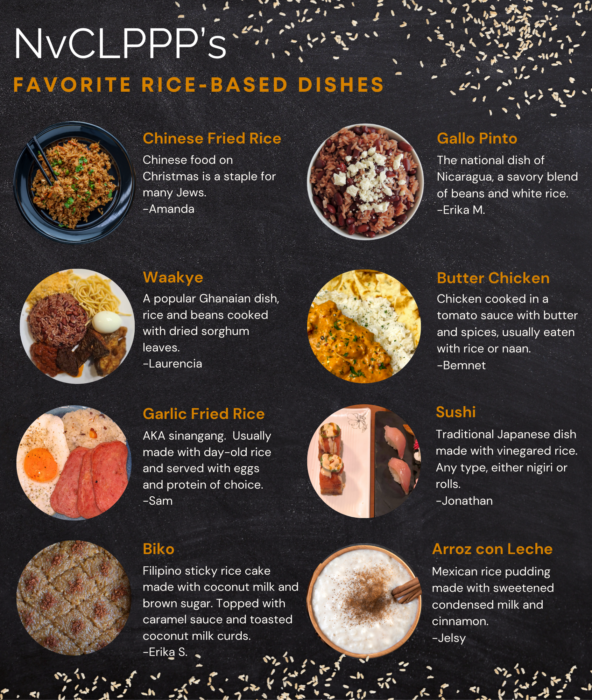
P.S. We love rice! The NvCLPPP team shared just some of our favorite rice-based dishes (see image below). I was delighted to learn how many different ways my colleagues enjoy rice for breakfast, lunch, dinner, dessert, and even as a snack. I now have two new dishes on my must-try list: Waakye and Biko. Yum!
*What’s a “ppb”?
“Parts per billion” refers to a unit of measurement used to quantify tiny amounts of something. It can be tough to picture. Imagine 1 ppb as:
- 1 penny in $10 million
- 1 inch in 15,738 miles
- 1 drop of water in a swimming pool
So when you hear “100 ppb arsenic” or “36 ppb of lead” think tiny amounts, but still important when it comes to children’s health.
References
- Food and Agriculture Organization of the United Nations. FAOSTAT: Food balances (2010– ). 2021 data summary. Published 2024. https://www.fao.org/faostat/en/#data/FBS
- U.S. Department of Agriculture, Economic Research Service. Rice sector at a glance. Published 2025. https://www.ers.usda.gov/topics/crops/rice/rice-sector-at-a-glance
- USA Rice. U.S. rice facts. https://www.usarice.com/thinkrice/discover-us-rice/us-rice-facts
- U.S. Food and Drug Administration. Supporting document for action level for inorganic arsenic in infant rice cereals. https://www.fda.gov/food/chemical-metals-natural-toxins-pesticides-guidance-documents-regulations/supporting-document-action-level-inorganic-arsenic-rice-cereals-infants
- U.S. Food and Drug Administration. Arsenic in rice and rice products risk assessment report. Published 2016. http://www.fda.gov/downloads/Food/FoodScienceResearch/RiskSafetyAssessment/UCM486543.pdf
- Houlihan J, Naumoff K. What’s in your family’s rice? Arsenic, cadmium, and lead in popular rice brands—plus 9 safer grains to try. Healthy Babies Bright Futures. Published May 2025. https://hbbf.org/sites/default/files/2025-05/Arsenic-in-Rice-Report_May2025_R6_SECURED.pdf