
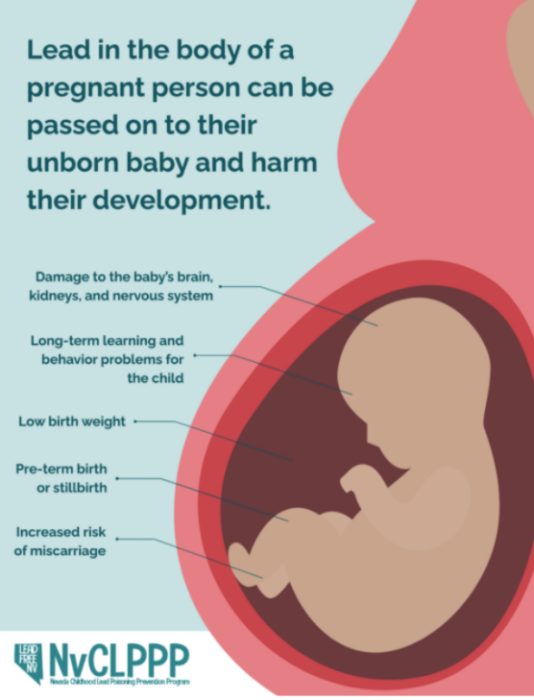
A pregnant person’s past or present exposure to lead can impact their unborn baby.1
Effects and Sources of Lead During Pregnancy
Lead exposure increases the risk of miscarriage, preterm birth, low birth weight, and high blood pressure. For the baby, it can affect brain and nervous system development, leading to learning and behavioral problems.2,3 These outcomes have been documented worldwide, including in countries where regulation is limited and lead-containing products remain in use.4,5 There is no safe level of lead in the body.5
Lead can enter the body during pregnancy from several everyday sources. Once in the bloodstream, it can cross the placenta and reach the developing baby.1,5 When the body needs extra calcium to support fetal growth and milk production, it draws on calcium stored in bone. During this process, lead that has built up in bone over time can also be released into the bloodstream.5-7
You may have a higher chance of exposure if you are:
- Living in or renovating a home built before 1978
- Working with or living with someone exposed to lead at work
- Using certain imported products (pottery, cosmetics, spices, folk remedies)
- Drinking water from plumbing with lead pipes or fixtures (EPA, 2023)
- Living in or migrating from regions where battery recycling, electronic waste burning, mining, fuels, or consumer products have contributed to elevated blood lead levels8,9
Cultural Practices and Pregnancy
Nevada is home to diverse cultural communities. Some traditional products and practices used within these communities have been found to contain lead, which is especially harmful during pregnancy or breastfeeding.
Sources of Potential Exposure
- Ayurvedic medications for pregnancy, such as Pregnita (nausea), Garbhapal Ras (fetal health or to have a male baby), and Ovarin (fertility), have been found to contain high levels of lead and were linked to miscarriages and elevated blood lead levels10
- Calabash chalk (nzu, mabele, calabar stone), eaten for morning sickness or cravings, contains lead and has been associated with higher umbilical cord blood lead levels11,12
- Geophagy (soil or clay eating) during pregnancy, practiced to relieve nausea or cravings, is tied to anemia, nutritional deficiencies, and exposure to lead13
- Pregnant women who practice geophagy in small-scale gold mining areas face especially high blood lead levels due to contaminated soil and mining environments14
See the Sources of Lead Exposure page for more information.
Lead Exposure During Breastfeeding
Lead in a parent’s blood can transfer into breast milk and be absorbed by the infant. Even small amounts may increase an infant’s blood lead level, which has been linked to impaired brain development, learning difficulties, and behavioral changes.2 A recent study also found that infants exposed to higher levels of lead in breast milk experienced delays in early language development during the first year of life.15
Breastfeeding is recommended in most circumstances because the benefits are well established. According to the CDC and the American College of Obstetricians and Gynecologists (ACOG), parents with blood lead levels below 40 µg/dL should continue to breastfeed. However, if the level is 40 µg/dL or higher, milk should be pumped and discarded until blood lead levels fall, and the infant should also receive a blood lead test.2,6
Pregnancy and Breastfeeding Guidance
The ACOG recommends reviewing lead exposure risk at the first prenatal visit 6 While the ACOG does not provide a single national questionnaire, our Lead Risk Questionnaire for Pregnant and Lactating Persons can be used as a tool to help identify possible risk of lead exposure. If you answered “Yes” or “Don’t know” to any question, ask your doctor for a blood lead test to determine if you have been exposed. If testing shows an elevated blood lead level, ACOG’s clinical guidance includes:
Management of Blood Lead Levels During Pregnancy and Breastfeeding
| Venous BLL (µg/dL) | Pregnancy Recommended Actions | Breastfeeding Recommended Actions |
| <5 | No follow-up testing; provide dietary guidance (calcium, iron) | Breastfeeding encouraged |
| 5-14 | Above, plus: remove exposure sources; counsel on avoidance; retest in 1 month; check maternal/cord BLL at delivery | Breastfeeding supported; test infant blood lead regularly |
| 15-24 | Above, plus: retest every 2-3 months. | Continue breastfeeding; test infant blood lead regularly |
| 25-44 | Above, plus: retest every 1-4 weeks, then monthly; consult clinician with lead experience. | Continue breastfeeding with infant testing; if infant BLL ≥5, pause until maternal level decreases |
| ≥45 | Above, plus: retest within 24 hrs and often thereafter; treat as high-risk pregnancy; consult specialist; chelation may be considered. | If maternal ≥40: do not breastfeed, pump/discard until <40. If maternal >20 and infant ≥5 with no other source: suspect breast milk, stop temporarily6 |
Prevention and Next Steps
Simple actions can help lower lead exposure during pregnancy and breastfeeding. These include:
- Talk to your healthcare provider about a blood lead test if you may have been exposed2
- Get enough calcium (1,000 mg/day for pregnant & breastfeeding adults), plus iron and vitamin C to help reduce how much lead the body absorbs5,7
- Run tap water before use. Water that sits in pipes can pick up lead. If your home does not have a lead service line, let the water run for 30-60 seconds. If your home does have a lead service line (the pipe connecting your house to the main water supply), let it run for 3-5 minutes. Always use a water filter certified to remove lead16,17
- Avoid eating, cooking, or storing food in imported, glazed, or decorative dishware or cookware. Be cautious with traditional medicines, remedies, cosmetics, and clays, as some may contain lead2
- Windowsills and other flat surfaces should be cleaned regularly with a damp cloth to help reduce the spread of lead dust. Pregnant women should avoid cleaning or being in the area during cleaning. The person cleaning should wear rubber gloves, washable clothing, and wash their hands thoroughly afterward18
For additional steps to reduce lead exposure, including healthy habits, cleaning tips, and proper nutrition, see our Preventing Lead Poisoning page.
References
- West Virginia Department of Health and Human Resources (WVDHHR). Pregnant Women and Lead. Accessed October 19, 2025. https://dhhr.wv.gov/wvchildhoodleadpoisoning/Pages/Pregnant-Women-and-Lead.aspx
- Centers for Disease Control and Prevention. Guidelines for the identification and management of lead exposure in pregnant and lactating women. December 1, 2021. Accessed October 19, 2025. https://stacks.cdc.gov
- New York City Department of Health and Mental Hygiene (NYC DOHMH). Lead Poisoning in Children and Pregnant Women – NYC Health. Accessed October 19, 2025. https://www.nyc.gov/site/doh/health/health-topics/lead-poisoning-children-and-lead-poisoning.page
- Taylor C, Golding J, Emond A. Adverse effects of maternal lead levels on birth outcomes in the ALSPAC study: a prospective birth cohort study. BJOG. 2015;122(3):322-328. doi:10.1111/1471-0528.12756
- World Health Organization. Lead poisoning. Accessed October 19, 2025. https://www.who.int/news-room/fact-sheets/detail/lead-poisoning-and-health
- American College of Obstetricians and Gynecologists. Lead Screening During Pregnancy and Lactation. Accessed October 19, 2025. https://www.acog.org/clinical/clinical-guidance/committee-opinion/articles/2012/08/lead-screening-during-pregnancy-and-lactation
- Ettinger AS, Lamadrid-Figueroa H, Téllez-Rojo MM, et al. Effect of Calcium Supplementation on Blood Lead Levels in Pregnancy: A Randomized Placebo-Controlled Trial. Environ Health Perspect. 2009;117(1):26-31. doi:10.1289/ehp.11868
- Bede-Ojimadu O, Amadi CN, Orisakwe OE. Blood Lead Levels in Women of Child-Bearing Age in Sub-Saharan Africa: A Systematic Review. Front Public Health. 2018;6:367. doi:10.3389/fpubh.2018.00367
- Navarro-Tapia E, Serra-Delgado M, Fernández-López L, et al. Toxic Elements in Traditional Kohl-Based Eye Cosmetics in Spanish and German Markets. IJERPH. 2021;18(11):6109. doi:10.3390/ijerph18116109
- Centers for Disease Control and Prevention. Lead Poisoning in Pregnant Women Who Used Ayurvedic Medications from India — New York City, 2011–2012. Accessed October 19, 2025. https://www.cdc.gov/mmwr/preview/mmwrhtml/mm6133a1.htm
- Public Health England. Alert issued to pregnant women in London following reports of toxic ‘antidote’ to morning sickness. GOV.UK. Accessed October 19, 2025. https://www.gov.uk/government/news/alert-issued-to-pregnant-women-in-london-following-reports-of-toxic-antidote-to-morning-sickness
- Vofo BN, Fotsing Ngankam Vofo GV, Ambo Fonge B, Nsagha DS, Obinchemti Egbe T, Nguedia JC. High umbilical cord blood lead levels and “calabar chalk” consumption amongst pregnant women in two hospitals in Cameroon. Pan Afr Med J. 2019;33. doi:10.11604/pamj.2019.33.109.13999
- Eberl EE, Minja DTR, Lundtoft LE, et al. Geophagia in pregnancy and its association with nutritional status – A prospective cohort study in rural north-eastern Tanzania. Int J Behav Nutr Phys Act. 2025;22(1):27. doi:10.1186/s12966-025-01721-y
- Thomas DSK, Asori M, Nyanza EC. The role of geophagy and artisanal gold mining as risk factors for elevated blood lead levels in pregnant women in northwestern Tanzania. Desai G, ed. PLOS Glob Public Health. 2024;4(2):e0002958. doi:10.1371/journal.pgph.0002958
- Naspolini NF, Vanzele PAR, Tótolo P, et al. Lead contamination in human milk affects infants’ language trajectory: results from a prospective cohort study. Front Public Health. 2024;12:1450570. doi:10.3389/fpubh.2024.1450570
- Minnesota Department of Health. Let it run … and get the lead out! – MN Dept. of Health. Accessed October 19, 2025. https://www.health.state.mn.us/communities/environment/water/factsheet/letitrun_english.html
- US EPA O. Basic Information about Lead in Drinking Water. February 2, 2016. Accessed October 19, 2025. https://www.epa.gov/ground-water-and-drinking-water/basic-information-about-lead-drinking-water
- United States Environmental Protection Agency; United States Consumer Product Safety Commission; United States Department of Housing and Urban Development. Protect Your Family from Lead in Your Home. U.S. Environmental Protection Agency; 2013. https://www.epa.gov/sites/default/files/2014-02/documents/lead_in_your_home_brochure_land_b_w_508_easy_print_0.pdf